











.jpg?v=1772553286476)

New York is the undisputed capital of American chess, shaped by over a century of immigration, iconic institutions like the Marshall Chess Club, and the public theatre of Washington Square Park. The city doesn't just nurture chess, it tests it. This piece explores the people, places, and culture that made New York a true chess mecca.
There are cities in which chess survives politely, preserved in cafés and clubs like porcelain behind glass. And then there is New York.
In New York, chess did not merely survive — it asserted itself.
From the late nineteenth century onward, as waves of European immigration reshaped the intellectual character of the city, chess took root in Manhattan’s clubs and private rooms. It arrived not as ornament, but as discipline: a language spoken fluently by émigrés from Berlin, Warsaw, Moscow, and Vienna. They brought with them not only boards and notation, but a seriousness of purpose. New York proved fertile ground.
By 1877, the Manhattan Chess Club had been established — an institution that would soon rival the great European societies. Its tournament of 1924, featuring Emanuel Lasker and José Raúl Capablanca, remains one of the defining competitions of the classical era. That such a gathering occurred in New York was no accident. The city had already become the intellectual capital of the New World.

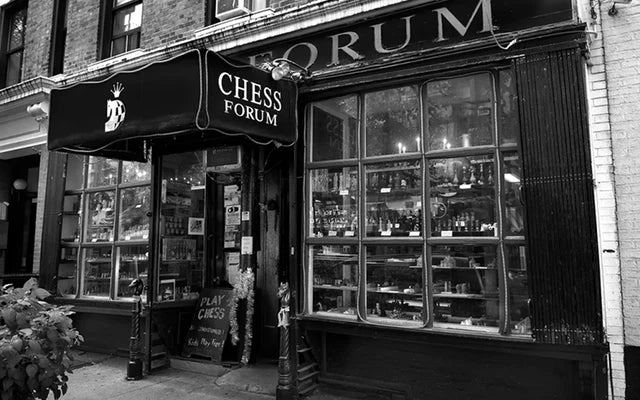
Outside the historic Chess Forum chess shop
The Marshall: Institution and Myth
If Manhattan gave chess its footing, the Marshall Chess Club gave it permanence.
Founded in 1915 by Frank Marshall, United States Champion and indefatigable ambassador for the game, the club evolved into something approaching a secular chapel. Its narrow rooms on West 10th Street have witnessed a century of ambition: young masters hunched over wooden boards, clocks struck in tension, reputations forged or undone in silence.
It was here that a teenage Bobby Fischer sharpened his instincts. Here that American chess, so long overshadowed by Europe, cultivated its confidence.
To step inside the Marshall is to enter continuity — not nostalgia, but inheritance.

A 1918 tournament at the Manhattan Chess Club
Fischer and the Assertion of American Will
Fischer was not merely a prodigy; he was a rupture.
Raised in Brooklyn and disciplined in Manhattan’s clubs, he absorbed the city’s uncompromising ethos. His victory in the 1972 World Championship did more than defeat Boris Spassky. It recalibrated cultural perception. For a brief moment, chess occupied the American imagination with the gravity usually reserved for geopolitics and finance.
New York stood at the center of that transformation.
Yet even absent myth, the infrastructure endured. Clubs remained active. Schools expanded their programs. Immigration continued to replenish the competitive bloodstream of the city.
Washington Square: The Democratic Counterpoint
And then there is Washington Square Park.
To describe it merely as “street chess” is to misunderstand its function. The park operates as a public theatre of calculation — a place where speed, wit, pride, and occasionally money are placed in contest beneath open sky.
Professors, hustlers, tourists, masters: all sit at the same stone tables. The atmosphere is unscripted, occasionally abrasive, always alive. The city’s egalitarian impulse expresses itself here most clearly. Strength, not pedigree, determines outcome.
Few capitals sustain such proximity between institutional prestige and public combat.

A chess game in Washington Square Park
Immigration and Discipline
New York’s chess culture has never been insular. Successive arrivals — particularly from the Soviet sphere during the twentieth century — imported rigorous training methods and uncompromising standards. Later generations from Eastern Europe and Asia strengthened the competitive fabric further.
Simultaneously, the city’s scholastic programs matured into one of the most formidable educational chess systems in the United States. Public school championships in Brooklyn and the Bronx carry an intensity that would surprise the uninitiated. The pipeline is neither accidental nor ornamental; it is cultivated.
When New York hosted the World Chess Championship in 2016, it did not signal resurgence. It signaled continuity.
A City in Which Chess Belongs
What distinguishes New York is not merely history, nor celebrity, nor infrastructure.
It is scale — and proximity.
Chess in New York does not inhabit a single social stratum. It exists in tension — between refinement and aggression, scholarship and spectacle, silence and noise.
The city’s character imprints itself upon the board. Moves are played with intention. Weakness is exploited without apology. Resilience is assumed.
Other cities nurture chess.
New York tests it.
And in doing so, it remains — unmistakably — the capital of American chess.
References
https://www.chess.com/article/view/manhattan-chess-club---a-quick-history
https://www.marshallchessclub.org/
https://en.wikipedia.org/wiki/Bobby_Fischer
https://www.fide.com/chess-in-new-york-a-walk-through-parks-clubs-and-history/
About the Author
Mariana Shalbaf is the co-founder and Creative Director of MIND GAMES, a luxury fragrance house inspired by strategy, artistry, and storytelling. With a background in visual arts and luxury branding, she leads the creative vision behind the brand’s distinctive fragrances, packaging, and narrative concepts.